
Introduction
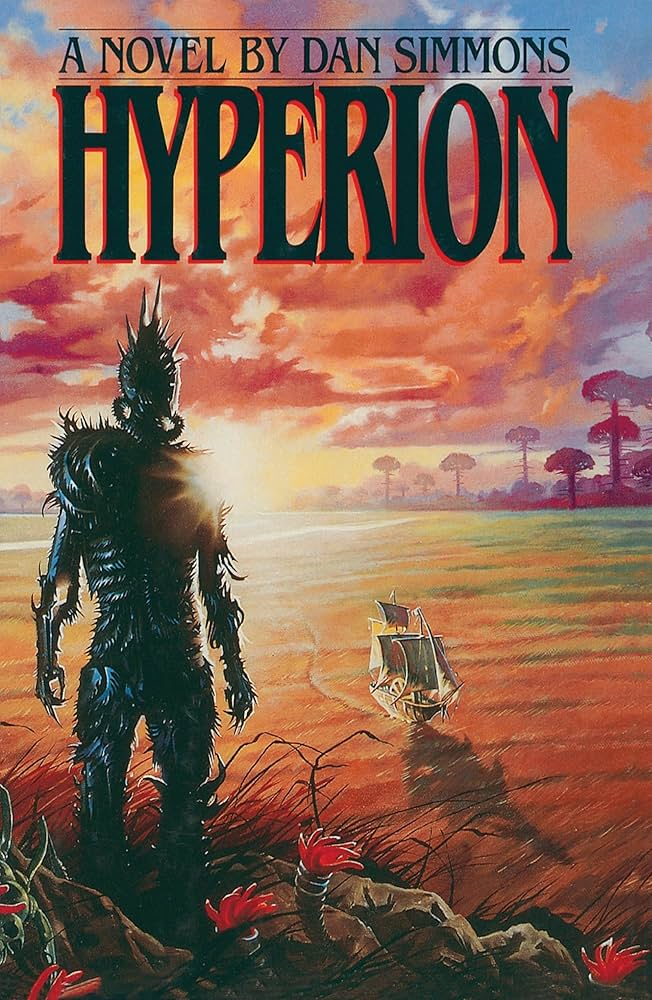
Hyperion by Dan Simmons is a science fiction novel published in 1989. It is the first book in the Hyperion Cantos series and won the Hugo Award for Best Novel, and well — it was a struggle to get through.
Synopsis
In a far-future galaxy ruled by the Hegemony of Man, war looms on the horizon. Amidst this chaos, seven strangers are brought together for a mysterious pilgrimage to the distant world of Hyperion — a planet haunted by a legendary and deadly entity known as the Shrike. Each of the pilgrims carries a deeply personal reason for facing this terrifying journey, and as they travel, they begin to share their stories, revealing a web of secrets, tragedies, and hopes.
Blending science fiction with literary depth, Hyperion unfolds like a futuristic Canterbury Tales, where each tale not only deepens the mystery of the Shrike and Hyperion itself, but also explores the vast and richly imagined universe Simmons has crafted. It’s a story about love, faith, time, and the cost of humanity’s pursuit of power and knowledge.
What I liked
The Shrike
Never before in my life have I encountered something as bone-chillingly terrifying and as intriguingly mysterious as the Shrike in any medium of fiction. This ephemeral entity is legitimate nightmare fuel and I fucking love it.
The Shrike earns its name from its horrific habit of impaling victims on a colossal, metallic tree known as the Tree of Pain. The most disturbing part? Its victims don’t die immediately — they remain alive, fully conscious, and writhing in agony. And the Shrike doesn’t stop at just a few; it does this to thousands, possibly millions. Imagine a towering metal tree, branches weighed down with the writhing bodies of the damned, their screams echoing endlessly — a true monument to suffering. That is so metal!
When you’re nicknamed the Lord of Pain and the Angel of Final Atonement, you best believe that there are going to be a sea of YouTube videos in your honour.
The Priest and Scholar Stories
As mentioned before, the book follows seven pilgrims on their journey to the Time Tombs and an inevitable encounter with the Shrike. The seven pilgrims take turns telling their stories of how they got to where they are and why they were chosen to embark on this journey.
The seven characters can be summarised as follows:
- The Priest
- The Poet
- The Soldier
- The Detective
- The Consul
- The Templar
- The Scholar
I’ll explain later why this structure doesn’t work for me as a whole. However, the stories of the Priest and the Scholar are some of the best reading experiences of my life. I was absolutely engrossed in both of these stories, and the funny thing is — their tones could not be any more different from one another.
One of them is an emotional family drama that had me tearing up, and the other is a mystery that continuously unfolds into something truly haunting. When isolated, these two stories are some of the best fictional writing I’ve come across. Unfortunately, this is where my praise for Hyperion ends.
What I Didn’t Like
I just don’t think this book was my cup of tea — and I can boil that down to one major issue: the structure. Nearly every gripe I have with Hyperion stems from this single choice. The pacing, character development, and emotional investment all feel like casualties of the novel’s structure.
Pacing
At the start, I mentioned struggling to get through this book — and that’s largely because of the pacing. The novel reads in a highly episodic fashion. Around 80% of the book is spent recounting the characters’ backstories, while only about 20% is dedicated to the present-day journey. That imbalance was a problem for me. So much so, that Hyperion is easily the book I’ve procrastinated the most on in my entire life.
There’s no gradual build-up of tension or narrative momentum. Instead, the conflict comes in bursts — self-contained within each character’s tale. In theory, that could make for a wild emotional ride, but in practice, it left me wanting to bang my head against something solid repeatedly. Each story ends on a high, then the narrative jarringly resets to the pilgrimage. Starting a new backstory felt like climbing a hill over and over again — without the payoff until much later in the tale. It became a test of sheer fucking willpower.
Characters
I didn’t care much for any of the characters — except Sol Weintraub (the Scholar). The other characters felt either undercooked or flat. Listen, I really wanted to connect with them, but I just couldn’t.
Maybe it’s a common critique of sci-fi that it leans heavier into ideas, worldbuilding, and plot than character development — but as someone new to the genre, I can’t say for sure. What I can say is that these characters just didn’t land for me at all.
Once again, I think the structure is to blame. With a cast this large and a narrative split into segmented backstories, it’s difficult to develop any meaningful, lasting connections. I needed more shared screen time between characters, more interaction, more depth. By the end of the book, the pilgrims felt like strangers — not only to each other but also to me.
Most of their personalities could be defined by a single character trait or archetype. Their identities felt paper-thin, and once their chapters ended, they kind of faded from memory. Worse still, a lot of the characters felt like they were passive observers in their own stories, making their conflicts and motivations feel hollow.
Biting Off More Than It Can Chew
There’s just way too much going on.
Too many characters. Too many themes. Too many unanswered questions. Too many weird jargon terms that are never explained. Too many out-of-place sex scenes. Too many references.
Dan Simmons doesn’t hold your hand in this book — at all. The world is dense with terminology, concepts, and tech that often go unexplained. Sometimes that can be intriguing. Here, it was frustrating. I constantly felt like I was playing catch-up with no clear direction.
Thematically, the book tries to juggle a lot — war, religion, grief, art, family, love, sacrifice, revenge, environmentalism, and more. While I appreciate the ambition, it ended up feeling like none of those themes were explored with enough focus or depth. The result is a novel that feels intellectually bloated and emotionally shallow.
Conclusion
Maybe this book just isn’t for me. I know Hyperion has a huge fanbase and clearly resonates with a lot of readers — so there’s definitely something there that didn’t quite land with me personally.
I get that it’s the first in a series and perhaps the story really shines in the later books, but honestly, this one didn’t do enough to hook me or build that anticipation. It left me more drained than intrigued, so I think it’ll be a while before I return to Dan Simmons’ universe — if at all.
Of course, this is just my experience and my opinion. Please don’t come at me with pitchforks and flaming torches trying to lynch me for writing something this blasphemous — I’m just a new sci-fi fan trying to figure out what all the fuss was about.
Comment your thoughts below! Do you agree? Disagree? Let me know! Until next time.
 Cosmic Wizard Archives
Leave a comment