
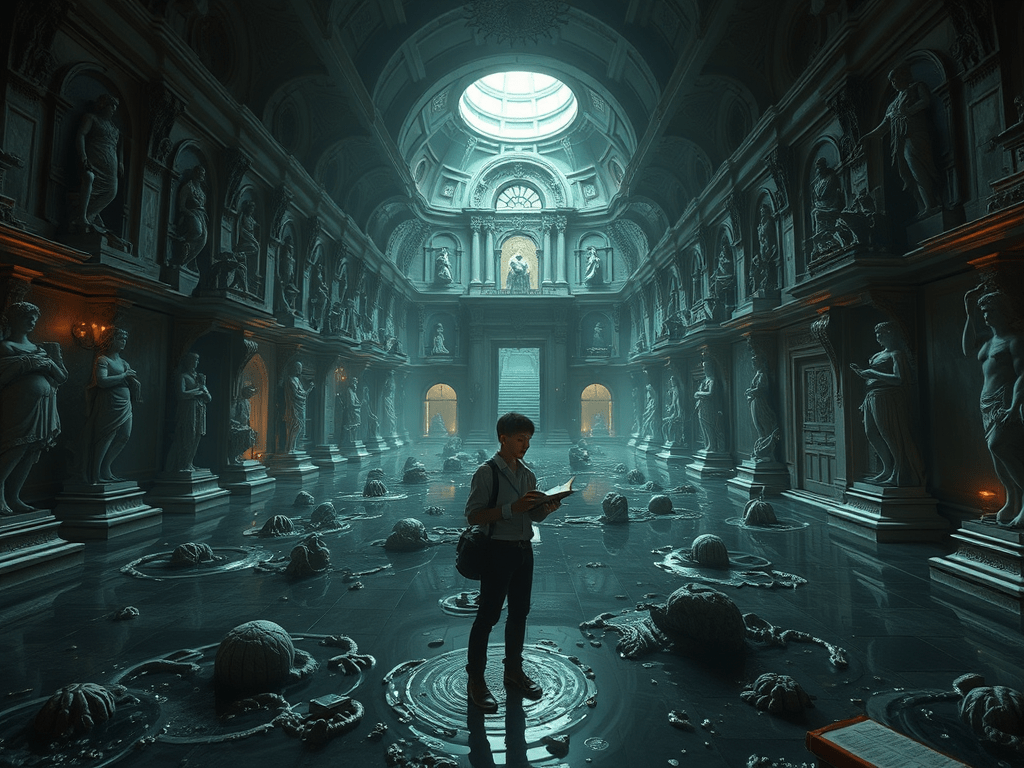
“The Beauty of the House is immeasurable; its Kindness infinite.” – Suzanna Clarke, Piranesi
Title: Piranesi
Author: Suzanna Clarke
Genre: Fantasy, Mystery
Publication Date: 15/09/2020
Publisher: Bloomsbury Publishing
I’ve never read anything quite like Piranesi. It’s an absolute fever dream, in the best way. A story that’s as hauntingly mysterious as it is emotionally compelling, set in a surreal, beautiful world packed with questions, and told through the voice of one of the most endearing protagonists I’ve ever read.
Synopsis
Piranesi lives in a seemingly infinite, labyrinthine house filled with statues and an ocean that periodically floods the halls. The house is his entire world, and he meticulously documents its wonders in his journals. He believes he has always lived there, with only one other person, “the Other”. As Piranesi explores, he uncovers clues that suggest his world is not what he believes, and a deeper, more complex reality begins to emerge.
Magic that Worked
The tone of Piranesi is flawless in my opinion. Told through a series of journal entries, the novel takes on a scholarly, almost archival approach. Every event is documented by Piranesi, immersing us in a world that feels both intimate and unimaginably vast. Early on, it becomes clear that Piranesi is an unreliable narrator — a choice that deepens the mystery and keeps us questioning the truth of the world and its inhabitants. The setting itself is dreamlike, eerie, and symbolic, adding a surreal layer to the narrative that feels both unsettling and profound.
Clarke handles sophisticated themes with remarkable grace — and at times, with surprising compassion. Her worldbuilding is excellent, not just in scope but in symbolism. Statues are scattered throughout the world, each designed to represent abstract ideas or evoke specific emotions in the observer. They don’t just decorate the world but define it, serving as physical manifestations of the book’s deeper philosophical nuances.
The plot unfolds like a Russian doll. With each layer peeled back, we’re given fragments that build toward answers, which in turn open up bigger, more interesting questions. The pacing is masterfully handled. I devoured the book in just three days, completely swept up in its rhythm with dialogue that is incredibly smooth, elegant, and often sincere.
As mentioned, the story is told entirely through Piranesi’s perspective, and it’s a perfect fit. Like the reader, he knows very little about the grander scheme of things, which makes watching him piece it all together so much fun. There’s a kind of childlike wonder to him — an innocence tempered by his analytical mind. His curiosity is pure, his reasoning sharp, and his emotional openness deeply moving. Piranesi is easily one of my favourite characters I’ve ever read: utterly unique, wonderfully written, and unforgettable.
Cracks in the Armor
I only have two small nitpicks — and they really are just that: minor gripes.
First, I found myself wishing Susanna Clarke had spent more time describing the unique details of the various rooms within the labyrinthine House, rather than focusing so much on their exact locations. I’m not usually a fan of overly descriptive prose (no need to spend a full page on the texture of the floor), but in this case, a bit more atmospheric detail could have added even more richness to the world.
That leads to my second point: the room location system. Piranesi navigates the endless halls using a meticulous system of numbering and cardinal directions. While I understand this is part of the worldbuilding — and a clever way to show his encyclopedic memory — it started to feel repetitive. After a while, I found myself skimming those directional references, which popped up more often than felt necessary.
But again, these are very minor personal preferences. None of it detracted from my enjoyment of the novel. Piranesi is a beautiful, mysterious, and singular experience. Go read it.
Conclusion
That said, Piranesi definitely won’t be for everyone. It’s not action-packed, there’s no defined magic system, and the protagonist isn’t chasing a clear, tangible goal. The story unfolds slowly, and abstractly.
But if you enjoy philosophy, exploring ideas and piecing together quiet mysteries, this will likely be your cup of tea.
It’s no surprise that Piranesi won the Women’s Prize for Fiction in 2021. It’s a beautifully crafted breath of fresh air — especially if you’re coming from the dense, sprawling worlds of epic fantasy like I am. For what it sets out to be, it’s near-perfect.
Final score: 4.5/5
A strange, elegant, unforgettable little gem.
Comment down below your thoughts on Piranesi. Until the next chapter!
 Cosmic Wizard Archives
Leave a comment