Author: Caleb Robinson

  • Piranesi Is Phenomenally Puzzling: A Labyrinth Worth Getting Lost In.

    Piranesi Is Phenomenally Puzzling: A Labyrinth Worth Getting Lost In.

    The Beauty of the House is immeasurable; its Kindness infinite.” – Suzanna Clarke, Piranesi

    Title: Piranesi

    Author: Suzanna Clarke

    Genre: Fantasy, Mystery

    Publication Date: 15/09/2020

    Publisher: Bloomsbury Publishing

    I’ve never read anything quite like Piranesi. It’s an absolute fever dream, in the best way. A story that’s as hauntingly mysterious as it is emotionally compelling, set in a surreal, beautiful world packed with questions, and told through the voice of one of the most endearing protagonists I’ve ever read.


    Synopsis

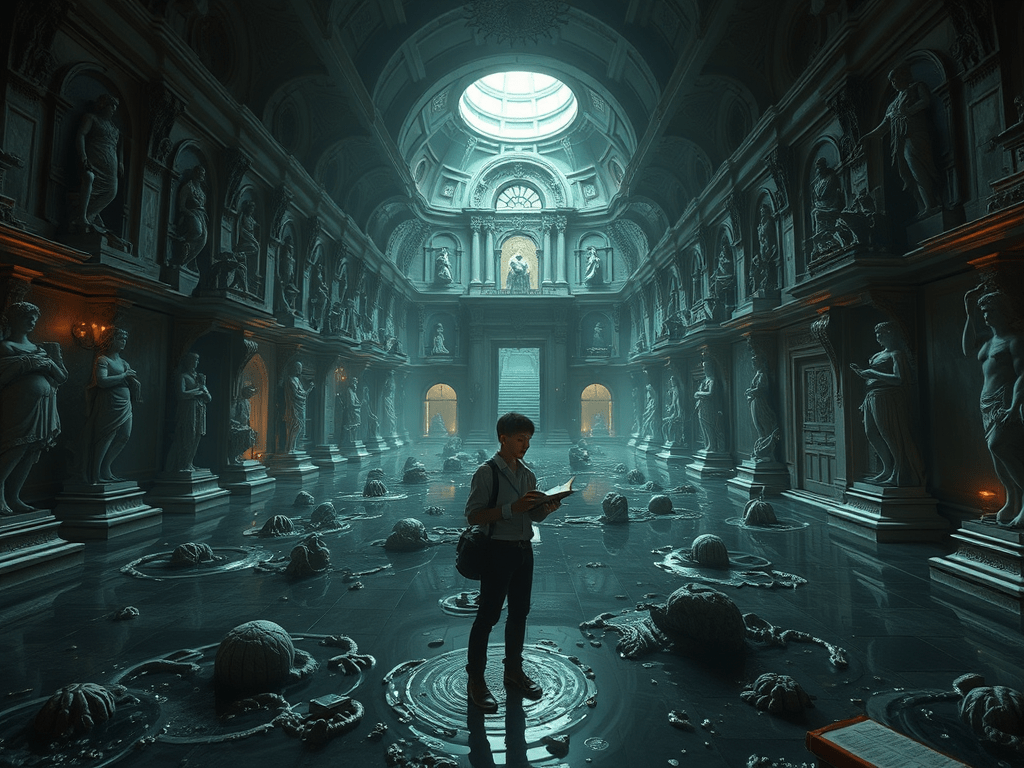
    Piranesi lives in a seemingly infinite, labyrinthine house filled with statues and an ocean that periodically floods the halls. The house is his entire world, and he meticulously documents its wonders in his journals. He believes he has always lived there, with only one other person, “the Other”. As Piranesi explores, he uncovers clues that suggest his world is not what he believes, and a deeper, more complex reality begins to emerge.


    Magic that Worked

    The tone of Piranesi is flawless in my opinion. Told through a series of journal entries, the novel takes on a scholarly, almost archival approach. Every event is documented by Piranesi, immersing us in a world that feels both intimate and unimaginably vast. Early on, it becomes clear that Piranesi is an unreliable narrator — a choice that deepens the mystery and keeps us questioning the truth of the world and its inhabitants. The setting itself is dreamlike, eerie, and symbolic, adding a surreal layer to the narrative that feels both unsettling and profound.

    Clarke handles sophisticated themes with remarkable grace — and at times, with surprising compassion. Her worldbuilding is excellent, not just in scope but in symbolism. Statues are scattered throughout the world, each designed to represent abstract ideas or evoke specific emotions in the observer. They don’t just decorate the world but define it, serving as physical manifestations of the book’s deeper philosophical nuances.

    The plot unfolds like a Russian doll. With each layer peeled back, we’re given fragments that build toward answers, which in turn open up bigger, more interesting questions. The pacing is masterfully handled. I devoured the book in just three days, completely swept up in its rhythm with dialogue that is incredibly smooth, elegant, and often sincere.

    As mentioned, the story is told entirely through Piranesi’s perspective, and it’s a perfect fit. Like the reader, he knows very little about the grander scheme of things, which makes watching him piece it all together so much fun. There’s a kind of childlike wonder to him — an innocence tempered by his analytical mind. His curiosity is pure, his reasoning sharp, and his emotional openness deeply moving. Piranesi is easily one of my favourite characters I’ve ever read: utterly unique, wonderfully written, and unforgettable.


    Cracks in the Armor

    I only have two small nitpicks — and they really are just that: minor gripes.

    First, I found myself wishing Susanna Clarke had spent more time describing the unique details of the various rooms within the labyrinthine House, rather than focusing so much on their exact locations. I’m not usually a fan of overly descriptive prose (no need to spend a full page on the texture of the floor), but in this case, a bit more atmospheric detail could have added even more richness to the world.

    That leads to my second point: the room location system. Piranesi navigates the endless halls using a meticulous system of numbering and cardinal directions. While I understand this is part of the worldbuilding — and a clever way to show his encyclopedic memory — it started to feel repetitive. After a while, I found myself skimming those directional references, which popped up more often than felt necessary.

    But again, these are very minor personal preferences. None of it detracted from my enjoyment of the novel. Piranesi is a beautiful, mysterious, and singular experience. Go read it.


    Conclusion

    That said, Piranesi definitely won’t be for everyone. It’s not action-packed, there’s no defined magic system, and the protagonist isn’t chasing a clear, tangible goal. The story unfolds slowly, and abstractly.

    But if you enjoy philosophy, exploring ideas and piecing together quiet mysteries, this will likely be your cup of tea.

    It’s no surprise that Piranesi won the Women’s Prize for Fiction in 2021. It’s a beautifully crafted breath of fresh air — especially if you’re coming from the dense, sprawling worlds of epic fantasy like I am. For what it sets out to be, it’s near-perfect.

    Final score: 4.5/5

    A strange, elegant, unforgettable little gem.


    Comment down below your thoughts on Piranesi. Until the next chapter!
    Leave a comment

  • Hyperion: A Masterpiece for Others, a Miss for Me.

    Hyperion: A Masterpiece for Others, a Miss for Me.

    Introduction

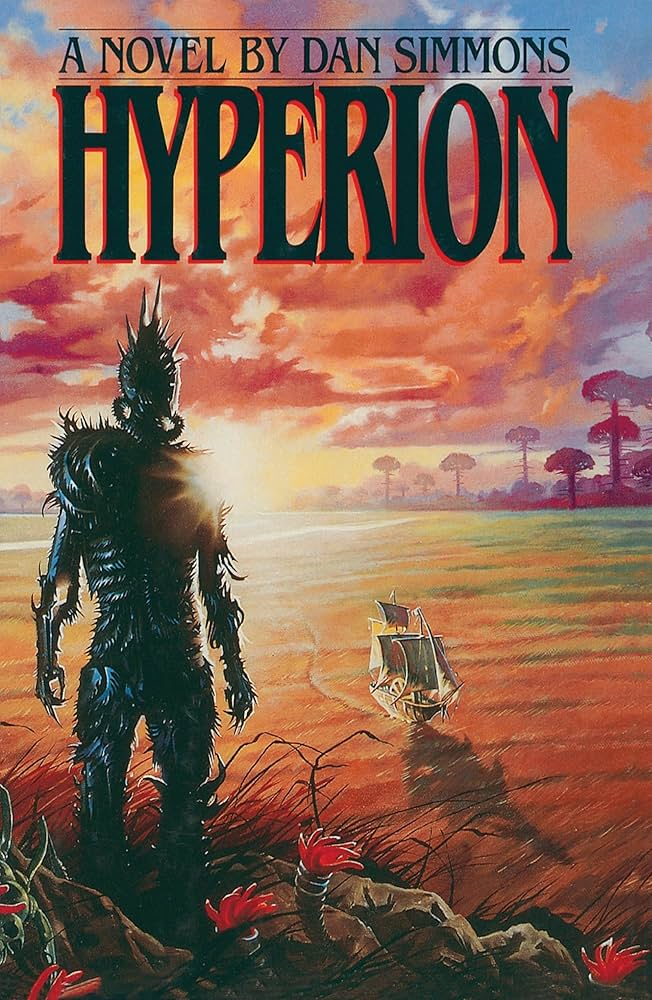
    Hyperion by Dan Simmons is a science fiction novel published in 1989. It is the first book in the Hyperion Cantos series and won the Hugo Award for Best Novel, and well — it was a struggle to get through.


    Synopsis

    In a far-future galaxy ruled by the Hegemony of Man, war looms on the horizon. Amidst this chaos, seven strangers are brought together for a mysterious pilgrimage to the distant world of Hyperion — a planet haunted by a legendary and deadly entity known as the Shrike. Each of the pilgrims carries a deeply personal reason for facing this terrifying journey, and as they travel, they begin to share their stories, revealing a web of secrets, tragedies, and hopes.

    Blending science fiction with literary depth, Hyperion unfolds like a futuristic Canterbury Tales, where each tale not only deepens the mystery of the Shrike and Hyperion itself, but also explores the vast and richly imagined universe Simmons has crafted. It’s a story about love, faith, time, and the cost of humanity’s pursuit of power and knowledge.


    What I liked

    The Shrike

    Never before in my life have I encountered something as bone-chillingly terrifying and as intriguingly mysterious as the Shrike in any medium of fiction. This ephemeral entity is legitimate nightmare fuel and I fucking love it.

    The Shrike earns its name from its horrific habit of impaling victims on a colossal, metallic tree known as the Tree of Pain. The most disturbing part? Its victims don’t die immediately — they remain alive, fully conscious, and writhing in agony. And the Shrike doesn’t stop at just a few; it does this to thousands, possibly millions. Imagine a towering metal tree, branches weighed down with the writhing bodies of the damned, their screams echoing endlessly — a true monument to suffering. That is so metal!

    When you’re nicknamed the Lord of Pain and the Angel of Final Atonement, you best believe that there are going to be a sea of YouTube videos in your honour.


    The Priest and Scholar Stories

    As mentioned before, the book follows seven pilgrims on their journey to the Time Tombs and an inevitable encounter with the Shrike. The seven pilgrims take turns telling their stories of how they got to where they are and why they were chosen to embark on this journey.

    The seven characters can be summarised as follows:

    • The Priest
    • The Poet
    • The Soldier
    • The Detective
    • The Consul
    • The Templar
    • The Scholar

    I’ll explain later why this structure doesn’t work for me as a whole. However, the stories of the Priest and the Scholar are some of the best reading experiences of my life. I was absolutely engrossed in both of these stories, and the funny thing is — their tones could not be any more different from one another.

    One of them is an emotional family drama that had me tearing up, and the other is a mystery that continuously unfolds into something truly haunting. When isolated, these two stories are some of the best fictional writing I’ve come across. Unfortunately, this is where my praise for Hyperion ends.


    What I Didn’t Like

    I just don’t think this book was my cup of tea — and I can boil that down to one major issue: the structure. Nearly every gripe I have with Hyperion stems from this single choice. The pacing, character development, and emotional investment all feel like casualties of the novel’s structure.


    Pacing

    At the start, I mentioned struggling to get through this book — and that’s largely because of the pacing. The novel reads in a highly episodic fashion. Around 80% of the book is spent recounting the characters’ backstories, while only about 20% is dedicated to the present-day journey. That imbalance was a problem for me. So much so, that Hyperion is easily the book I’ve procrastinated the most on in my entire life.

    There’s no gradual build-up of tension or narrative momentum. Instead, the conflict comes in bursts — self-contained within each character’s tale. In theory, that could make for a wild emotional ride, but in practice, it left me wanting to bang my head against something solid repeatedly. Each story ends on a high, then the narrative jarringly resets to the pilgrimage. Starting a new backstory felt like climbing a hill over and over again — without the payoff until much later in the tale. It became a test of sheer fucking willpower.


    Characters

    I didn’t care much for any of the characters — except Sol Weintraub (the Scholar). The other characters felt either undercooked or flat. Listen, I really wanted to connect with them, but I just couldn’t.

    Maybe it’s a common critique of sci-fi that it leans heavier into ideas, worldbuilding, and plot than character development — but as someone new to the genre, I can’t say for sure. What I can say is that these characters just didn’t land for me at all.

    Once again, I think the structure is to blame. With a cast this large and a narrative split into segmented backstories, it’s difficult to develop any meaningful, lasting connections. I needed more shared screen time between characters, more interaction, more depth. By the end of the book, the pilgrims felt like strangers — not only to each other but also to me.

    Most of their personalities could be defined by a single character trait or archetype. Their identities felt paper-thin, and once their chapters ended, they kind of faded from memory. Worse still, a lot of the characters felt like they were passive observers in their own stories, making their conflicts and motivations feel hollow.


    Biting Off More Than It Can Chew

    There’s just way too much going on.

    Too many characters. Too many themes. Too many unanswered questions. Too many weird jargon terms that are never explained. Too many out-of-place sex scenes. Too many references.

    Dan Simmons doesn’t hold your hand in this book — at all. The world is dense with terminology, concepts, and tech that often go unexplained. Sometimes that can be intriguing. Here, it was frustrating. I constantly felt like I was playing catch-up with no clear direction.

    Thematically, the book tries to juggle a lot — war, religion, grief, art, family, love, sacrifice, revenge, environmentalism, and more. While I appreciate the ambition, it ended up feeling like none of those themes were explored with enough focus or depth. The result is a novel that feels intellectually bloated and emotionally shallow.


    Conclusion

    Maybe this book just isn’t for me. I know Hyperion has a huge fanbase and clearly resonates with a lot of readers — so there’s definitely something there that didn’t quite land with me personally.

    I get that it’s the first in a series and perhaps the story really shines in the later books, but honestly, this one didn’t do enough to hook me or build that anticipation. It left me more drained than intrigued, so I think it’ll be a while before I return to Dan Simmons’ universe — if at all.

    Of course, this is just my experience and my opinion. Please don’t come at me with pitchforks and flaming torches trying to lynch me for writing something this blasphemous — I’m just a new sci-fi fan trying to figure out what all the fuss was about.

    Comment your thoughts below! Do you agree? Disagree? Let me know! Until next time.

    Leave a comment